Showing posts with label Data. Show all posts

Saturday, April 23, 2016

It's the Final Countdown......Part I

                                                                              *image from wikipedia.org

It's the final countdown (cue drums and bad 80s hair)....fourth quarter. I have 33 school days to support my students in reaching their goals, whether that means we are trying to improve a report card grade, pass the EOGs, avoid behavior referrals, or have better attendance; the time is now. So, what am I doing?

Right now 
I am using my report card conference form to review third quarter report cards and help students make fourth quarter goals for specific subjects. I will also be starting my test success small groups with third and fifth graders who need that extra push to pass the EOGs. The fifth graders are students who missed passing last year's EOG by one to two points, and the third graders are "bubble students" as determined by the "Beginning of Grade" (BOG) test data and mock EOG data.  

Do you see a theme here? All of these interventions require looking at data to determine who I should be supporting; they require data to determine what the next steps should be for students as they move toward their next goals.  The focus is on making progress, moving forward, and having a growth mindset.  Good teachers do a great job of using formative assessments to inform their interventions and drive instruction.  Counselors can do the same.

You may remember this goal-setting post from the beginning of the year where I used my new goal-setting form (FREEBIE NOW at my TPT store), SMARTboard slides,  and lesson plan to help fifth graders create goals for the year.  Most years, I help students create goals in September and then I move on, hoping, wishing, and crossing my fingers that they will reach them. This year I challenged myself to return to goal setting and do more.

Using Data:  The Objective
I decided I wanted to use minute meetings to follow up with students about their goals and collect qualitative data that would inform my next steps in supporting them with academics.  I knew I wouldn't have enough time to interview ALL 120+ fifth graders from ALL six classes so I worked to get a majority sample from a majority of the classes. I ended up talked to students from four out of the six classes.

The Plan
I had hoped to begin my minute meetings as soon as first quarter ended (end of November), but "school counseling" happened, and they didn't begin until December with the bulk of the meetings being completed in early January.

I created a Google survey to review goals with students and asked the following (see below):

  • Did you meet your first quarter goal?
  • If not, why not?
  • Do you have a new goal for third quarter?
  • What would help you most in reaching your goal?


The Outcome
Here is some of my survey data (I love the summary of responses view in Google!).  It was helpful for me to see that 37% of the students I interviewed did not meet their first quarter goal and 21% couldn't remember what their goal had been.  It validated my decision to return to goal setting and take time to collect formative data on how to support students best in my next steps.


As I talked to students about what skills would help them be most successful for the rest of the year (below), several habits became prominent:  Organization of Time, Study Skills, and Listening Skills. The "other" responses were typically students saying they needed help in TWO areas, which I typed out. After reviewing the percentages, written responses, and getting feedback from the classroom teachers, I decided to focus on study skills and organization of time.


Next Steps
I created two academic habits lessons for my fifth grade students, personalized to their needs. Teachers were given the option of having both lessons or choosing the one that best met their students' needs. Most of the teachers chose both lessons.  Part TWO of this post will review those lessons.

Reflection
I was proud of the growth I made in using my data collection as a formative tool to drive my instruction and interventions.  Feeling comfortable with data and using it effectively is one of the great challenges that most school counselors face, myself included. I have gone from groaning when I am presented with data to getting excited about  it. My perception has shifted. I now realize that student data is not the end of the story; it's the the first paragraph of the next chapter as students continue their story.

Happy Counseling! ~ Angela

Sunday, April 3, 2016

What's Inside Your HeART??


Well, hello again.....I hope these spring months have been good to you and you have been recharged and rejuvenated over spring break. I know the break was a welcome chance to unplug and relax for me!!! I have been committed to prioritizing family & friend time and "ME" time in 2016, and I have really stuck to it!  Remember my New Year's post?! Of course, this commitment means the blog posts have not been plentiful, but when I do write, I hope you will find it useful.

March was a BUSY month for me, and I think that is typical for most school counselors. Students (and staff) are tired and ready for a break, and problem solving skills tend to deteriorate. There was a lot of student conflict, and I found myself using my mediation form and problem solving card OFTEN! I also taught some really fun diversity lessons to my grade levels, which I will share in a future post.  I saw a lot of students individually and got a chance to implement some of the skills I wrote about in my post from the ASCA conference last July.  In particular, I loved using the feeling heart from the Counseling with HeART session by Julie Ford to help students, especially younger ones, process their feelings

I start out by having students draw a heart and choose colors to represent each feeling. Then, they color in sections of the heart to represent how much of each feeling they currently have.  After brainstorming behavior strategies, disputing irrational thoughts, coming up with a solution-focused plan (or whatever theory I am currently using to help!), the student re-colors the heart to show if any feelings have changed.  You can also have the student reflect on the chart from one session to the next if it's a more complicated problem and needs more time to address. In addition to allowing the student to be growth-oriented and giving them a concrete visual that feelings can change and improve, it also provides awesome pre and post data for counselors! Check out some student examples below.

Heart Example #1:  In this example there is no feeling key, but the student colored in the following feelings:  Angry (red), Sad (blue), Happy (Purple), Scared (Green).  After our session, the student colored over half the red and all the green with purple to show increased happiness. We still had work to do on the rest of the anger and sadness, but it was a start!


Heart Example #2:  My second example does include a feelings key, which I really liked creating while the student and I talked about different feelings you can have. This student was feeling very angry when we started the counseling session. After working together, the student colored in about 75% of the heart purple to show we had figured out appropriate ways to get rid of angry feelings and feel more happy.  Again, we still had to work on that last 25%, but we had definite progress.


I liked this art feelings activity so much that I created a template I could pull out of my individual counseling folder anytime it would be useful for a student. I have found that having resource folders for common issues ----conflict, anger, friendship, family, perspective-taking, etc.---- in a hanging wall organizer helps me be ready when students come in with concerns. It also saves me a ton of time because I can quickly find a visual resource to help focus our individual session instead of creating something new each time and spinning my wheels. With so many students and so little time, it has become a great time-saver! 

For this template, you might have a younger student that only lists two or three feelings in the feelings key or an older student who is able to discriminate 4 or 5 feelings with different colors that need to be represented. I included six boxes for different colors, but you can always add more boxes. Hundreds of you got this freebie in its first weeks on TPT, and you can still find it here as part of my DOLLAR DAY items on my Life on the Fly TPT Store


Enjoy and Happy Counseling! ~ Angela


Wednesday, February 25, 2015

Say YES to MTSS!

 
TPT is having a sale- Click the image to see what you can scoop up for a discount at the Life on the Fly TPT Store!


RtI. MTSS. SST. SAT. A-Team.  The evolution of documented interventions and progress monitoring in school systems has been long and full of  paperwork. And no matter the acronym used in your county, Response to Intervention (RtI)/Multi-Tiered System Support (MTSS) is a process school counselors need to be involved in.  However, talking about RtI/MTSS isn't particularly exciting.  In fact, many school counselors prefer to not be overly involved in the process or only interact with the RtI/MTSS team when a student behavior issue arises.  You may only be called in to do an observation or help out with a Functional Behavior Assessment (FBA) and Behavior Intervention Plan (BIP).  Wow.....there are A LOT of acronyms!

My experience with MTSS has been long and varied depending on my school and the personnel available. I have always been a part of the team but was not the coordinator until I switched schools a few years ago.  Although it does take up more of my time, I have found ways to turn my coordinator position into a win-win for my school counseling program.  Here's how:

1.  Use the Data:  Remember the post about my     3-5 report card conferences and my Stuey Lewis book club with second graders?  Those interventions were all based on MTSS data at the Tier 2 or Tier 3 level.   My co-counselor and I are also meeting with first and second grade students on Tier 2 about general academic habits such as homework hygiene and paying attention in an attempt to keep them from moving to Tier 3.  At my school, primary students have a developmental report card that is not as conducive to report card conferences. In addition,  many of the students I see in individual counseling have come to my attention through Tier 3 MTSS data.

2.   Collaborate and Consult with Teachers:  My monthly MTSS PLC time is often the only time I get to sit down with an entire grade level at one time.  Everyone's schedules are hectic and it is difficult to grab more than 5 minutes with someone as you walk down the hallway to your next lesson, much less an entire grade level.  We have set aside one day/month when all grade levels meet during their planning periods to discuss student data, intervention plans, and the MTSS process.  These conversations have been the catalyst for a new homework club I am starting with fifth graders (more to come on that in a future post!) and additional attendance interventions for students as teachers express their concerns.

3.   Learn About Academic Interventions:  Many school counselors were not teachers prior to entering this profession and sometimes we feel like we are at a disadvantage when we can't throw out educational jargon like TRC (Text to Reading Comprehension), ORF (Oral Reading Fluency), and phonemic awareness or talk about bubble maps with ease.  MTSS is a great place to learn! I didn't know a lot about Symbaloo's until I was in a MTSS meeting with a reading interventionist and now I use a Symbaloo Webmix for e-books when I do a computer lab lesson with my Kindergarten students. I certainly hadn't heard of the Florida Center for Reading Research prior to being involved in MTSS and now I can talk about reading interventions with any grade level.  No school counseling graduate program would have ever taught me that!

The point is, no matter the roles you undertake at your school, you can use them to your advantage in your comprehensive school counseling program.
           So think outside the box, keep learning, and Happy Counseling!
                             ~ Angela

Monday, November 24, 2014

Plickers...Things That Make You Go HMMMMM............

                       
      TPT Life on the Fly Store Black Friday Sale---Get Ready!!


Apparently I have been living under a rock because I had never heard of Plickers until last week when one of my lovely colleagues forwarded me an article about it. So, I feel like it is my duty to write about them just in case there are other poor school counselors like me who need to see the light.  Plickers are one of those technology tools that make me go HMMM.....First, because I don't really understand how they work;  Second, because I think the person who invented them is BRILLIANT;  Third, because I bet the people who sell the ultra-expensive clicker systems are probably pretty annoyed right now; Fourth, because they are going to totally revolutionize my classroom guidance lessons.

You see, I have talked in numerous blog posts about my data collection methods for pre and post tests in classroom guidance lessons. You may remember seeing something that looked like this when I talked about character trait lessons (right). 
I dutifully collect my pre and post numbers in EVERY class whatever the multiple question may be.  Typically, I ask students to put their heads down and raise their hand for the one answer choice they think is correct.  It has always worked fairly well although I frequently have to remind students about voting ONLY ONE TIME, keeping their eyes closed so they don't peek at others' votes, and raising their hands high so I can get an accurate count.  And then came Plickers......

If you go to their website there isn't a TON of information so I want to let you know how I set up this incredible tool for my lessons.  Disclaimer: You WILL NEED a smart device to use Plickers (iPhone, iPad, iPod, etc.)

1. Create a FREE account on Plickers.com.
2. Go to the "Library" tab and type in the question you want to ask your students. You can have up to four multiple choice answers or make it a True/False question.
3. Underneath your question click "Add to Plan" and choose if you want to use the Demo class or add a new class.  (I kept it under Demo class the first time, but I plan on creating a class for each grade level I work with and adding specific questions to that grade level to keep it more organized.)
4. Click on the "Cards" tab and print out your Plicker cards. I chose to print the 40 card large font version since I will be using these with Kindergarten students as well as older students. I will use the SAME cards for each lesson.
5. Download the FREE Plicker App on your smart device.
6. In the app, click on the class where you saved the information so that you can see your question.  Then, press the CAMERA icon. 

At this point, you need to be in a classroom asking your question. Students will look at their unique Plicker code and decide if they think the correct answer is A, B, C, or D (I only had A-C answer choices for my second grade lesson so they ignored the D option).  Whatever answer they want to choose should be AT THE TOP of their Plicker code when they hold it up for you to scan (In the Plicker code at the top of this post, they would be choosing answer D).

Before you start scanning the students' answers, you can pull up the Plicker website on a Smartboard or LCD projector and click on "Live View." This view allows the students to see their answers being taken by your smart device as you walk around the room and scan the Plickers (right- Student View). If you only taught one class/one grade level you could also assign names to each Plicker card to assess who needed reteaching or remediation if that student picked the incorrect answer.  For my purposes, that would be way too time intensive so I just note who still doesn't have the right answer in my post test and check in with them later. Typically it is 2 kids MAX. 

The best part is revealing how the students did after you have scanned all the cards.  Click on the Graph View to see a chart like the one below.  If it's the pretest, you can discuss the results with students and have them predict how many students will have the correct answer AFTER the lesson.  Remember to make sure you are really emphasizing the correct answer and giving clear instruction so they have a chance to meet that goal!

So, there is my brief overview of Plickers.  Leave a comment if you think you can use this tool at your school! I would love to hear what you think.  Also, on a side note, I hope everyone has a wonderful Thanksgiving. I am truly thankful to have this blog to connect with all of you each day. 

Happy Turkey Day and Happy Counseling!  
~ Angela

Sunday, October 20, 2013

Visibility: Part II

Do your staff members know what you do at school? Are they aware of the value you bring to students, parents, other staff members, administration, and the community as a whole?  Advocacy is an important word that school counselors use when we are talking about students.  We want to advocate for students who may not be having their voices heard so they can be successful at school.  However, we also need to advocate for ourselves as professional school counselors. 

Our job is often measured in changes that may go unnoticed by others during the fast-paced, high stress weeks of school (surely that's not just my school ;o)  ); the child who can finally walk down the hallway to class instead of crying and fighting to stay in the car every morning because they know you will be there to help them, the student who doesn't mind taking Accelerated Math tests anymore because you worked with her on positive thoughts and anxiety, and the student who went from four negative reports home a week to zero because you worked on and kept practicing specific behaviors for the classroom.  These are all great improvements, but we have to do more.  Here are some examples:

1.  Morning Show/Newsletter/Website/Parent Letters: I am certain that most  school counselors have websites and may send home updates about what they are doing at school.  If not, it is a great way to inform parents of the lessons, programs, groups, etc. that you are offering at school. I used to have a Weebly website, which I loved, until I moved to a new county that didn't allow it. Now, I just use the template that is required and don't get to have as many of the bells and whistles on my site. However, I am lucky to be included in the "Specialist" (music, PE, art,  etc.) quarterly newsletter that is sent home to all students. I write up my articles about what I am doing and make sure to include my website link so parents can access additional information.

 Also, I LOVE going on the Morning Show at our school to talk about events that are going on.  My media specialist is great about fitting me in whenever I want.  I even made this GoAnimate cartoon to share during the Morning  Show at the beginning of the year, although I am still waiting for the correct cord to make it technically possible to show it to ALL students (some have seen it in groups with me).   Check it out:
School Counselor Intro by apoovey on GoAnimate


2. Staff Meetings:  Each year I request to be put on the agenda at an opening staff meeting so I can share my plans for the year.  I include any new information that has been passed down from the county  level, an overview of my annual plan for the year, and my specific action plans based on data.  I use PREZI because it is perfect for my goal of just focusing on the "big picture" information while I verbally share the details, and it is much more engaging to watch.  Here are some examples of information I include.


I love the ASCA National Model so I want my staff to have at least heard of this framework. I also reintroduced the Guidance Essential Standards to them this year after mentioning it at another staff meeting last year.


Here are my action plans for the year written in a very general way.  I focus on one specific plan for each of the ASCA domains (academic, personal/social, and career), and then I always include a plan addressing attendance. If kids aren't at school, how can they be successful?!


The annual plan information gives an overview of how I will be interacting with them during the year:  classroom guidance, small groups, schoolwide programs, and monthly activities that will involve them.

3.  School Advisory Council:  I haven't always had a school advisory council, but I think it is a good way to get feedback and publicize your program. The people included are my fantastic co-counselor,  a 3-5 teacher who is also a parent, an administrator who is also a parent, a specialist, and a K-2 teacher. I am also on the School Improvement Team, which allows me to share a lot of information about what I am doing, but I like that the advisory council's sole focus is the school counseling program.

Whatever strategies you use, make sure to let people know that your job as a school counselor is essential to the students, staff, and families you work with each day.   Happy Counseling!  ~Angela

Monday, October 7, 2013

Candy: Works Every Time!

Here is a summary of the Perseverance I presented to my older kiddos!

Fourth and Fifth Grades

We started with the same pre-test survey in fourth and fifth grades that I had used in the lower grades, although we added another answer choice to match the older students' higher developmental level.  Then, the fun began!  I chose four students to sample Warheads in front of the class.  They all tasted them at the same time, and I immediately  got one word from each student that described how it tasted.  It was pretty entertaining to see the looks of disgust on their faces and hear "terrible", "sour", "awful" as their adjectives.  Then, I asked them for another word after approximately two minutes.  They shared words like "delicious", "scrumptious", and "good".  We brought this icebreaker back to Perseverance and continuing to try even if something is "terrible" initially.


Then, I introduced the choices we can make with our thoughts when faced with a difficult situation.  I acted out a "trashy" thought and a "recycled thought" (my version of positive thoughts).  The students got a chance to check their understanding of these thoughts with the Kooshball game on our Smartboard (on TPT here).  This game always brings out a lot of student volunteers!  Each time they threw the kooshball (softly) at the Smartboard, a new thought would pop up and the students would decide if it was "trashy" or "recycled". Our final work product to encourage application of their learning was a "What's in Your Head?" sheet that I adapted from Pinterest.  Students drew images of their Smart Goals for the year (see post here) and then surrounded them with recycled thoughts they would use to encourage Perseverance.  They did a really great job, and I am going to use them on a bulletin board, which I will share with you in the next couple of weeks.   
Happy Counseling! Angela


Saturday, September 28, 2013

Perseverance: Keep On Keeping On!

I switched around my monthly character traits this year to match my school counseling annual calendar and complement the units I had planned for each month.  Perseverance ended up being my first character trait as I talked about goal setting for the year. I am in the specialist rotation for Kindergarten so I handle their lessons a little differently, but I created Perseverance lessons for 1st/2nd, 3rd, and 4th/5th grades.

My general classroom guidance framework for character trait lessons is:
  •  Introduce the Objective of the Lesson
  • Collection of Pre-test Data 
  • Icebreaker/Hook
  • Video or Book to model the character trait
  • Comprehension check with my students
  • Application of knowledge in an activity
The collection of data has been a work in progress over the last several years as I have focused on simplifying and streamlining my process. I used to collect WAY TOO MUCH DATA and then would never do anything with it because it was too overwhelming and took too much time to analyze.

Now, I typically use a quick multiple choice question as a pre/post test. I ask  students to vote on the definition they think fits best with the character trait word.  Younger students have three multiple choice answers and older students have four multiple choice answers.  You'll see the Perseverance example I used with first and second graders. I add variety by having the students do different activities to share their answers.  Depending on the grade level, students will stand up for the answer they think is correct, go to the corner of the room that matches the letter they are choosing, place sticky notes next to the answer they like best, or simply put their heads down and raise their hands for their choice. After our lesson, I repeat the activity and note the change in numbers.  It is a fast, effective way to document data for each of my classroom guidance lessons.

Here's a brief summary of a couple of my Perseverance lessons:


First and Second Grades 

I read Winners Never Quit by Mia Hamm. 
Then, I introduced a kinesthetic activity to get the students moving.  I brought my glitter soccer ball (a big hit with the kids!) and we formed a large circle. I started by asking the students what skills may be hard to learn in first and second grades. We rolled the ball among us as students brainstormed.   Then, I asked students what they wanted to be great at by the end of the year using the same process.  After brainstorming, the students worked on creating a "Reaching My Goal" booklet.  They drew illustrations for the pre-written pages (will add picture soon).


Third Grade

After getting pre-test data in third grade, my co-counselor began with a rhythm activity. She started out with a simple clapping rhythm that the kids mimicked.  Then, she added complexity to the rhythm with new patterns.  (I was able to get an action shot for you!)  By the end, it was almost impossible for the students to follow along.  She related the increased difficulty to Perseverance in third grade.  We showed this video from Greatschools.org.  It used the  word "Persistence" instead of Perseverance, but we explained the similarities.  The kids loved and understood the drumming analogy since we had just completed our rhythm activity.  Finally, the students brainstormed skills that could be difficult in third grade, and they completed a Goal Setting sheet (see below).
I loved teaching these lessons, and will share my 4th/5th grade lessons next.  Happy Counseling! ~ Angela

Thursday, June 20, 2013

Double Take: What Are You Going to be Next Year?

You  probably remember that I asked my fifth grade students during their middle school transition lessons what they wanted to be next year. I think it's that time of year where I, and all educators, need to ask ourselves that same question. I went through a lot of changes this year starting in a new county and a new school.  I was hired seven days before school started so I didn't have the luxury of taking a lot of time to plan my counseling space or reflect on data that would help me shape my school counseling program.  This year will be different.  I know my co-workers.  I know my administration and the students.  I know the school culture and how I need to go about delivering my school counseling program.  So, I'm thinking, "What do I want to be next year?"

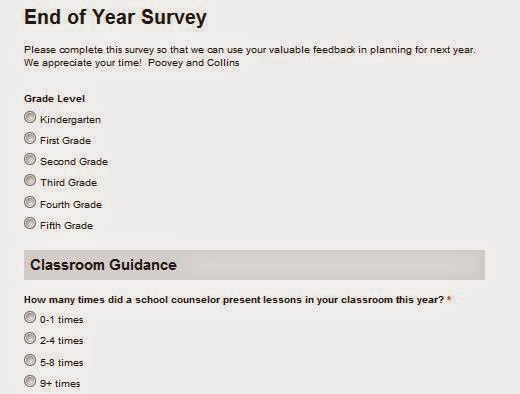
I have some data to help me answer this question so that I can focus on specific objectives Day One of next year. Some of my data came from an end of the year survey I gave to my colleagues the last week of school.  I used Google Docs and created a nine question form that covered individual counseling, small group counseling, classroom guidance, and some schoolwide programs (see below to get a sense of what I asked).  Then, I emailed it to the staff as a form so they didn't even have to click on any links or open other windows.  The results provided some really positive perception data, which I can format into charts and graphs and use for planning purposes, as well as share with my administration.


I also went through attendance data and behavior data that I had been gathering all year so I would have some concrete baseline data for interventions next year. 

Now, I love my summer so I won't be burning the midnight oil on school stuff all the time.  However, there are some fun things (and some more boring things) I can't wait to finally have time to piddle with.  It doesn't feel like work when I am on my porch with fun snacks, enjoying the weather, and can really think about some of the new ideas I want to try.  So, here is a list of what I'll be writing about this summer:

                              Top 5 List of Summer 2013

1.  Decorating my office....Yay!  I already have some fun inspiration from Pinterest of projects I want to make for my office, and I kind of started during a little during workdays. I want to hear your ideas, too!
2.  Working on grants-  I have been only mildly successful in earning grants for some of the projects I want to try at school. So, I am going to give it a shot over summer and step up my game!
3.  Researching books-  Student book clubs are a huge love of mine, and I have some reading to do to find new material  for next year.
4.  Guidance Essential Standards- I am going to work hard to organize the essential standards into a matrix that works for my classroom guidance schedule.  If you know of something like this that already exists, please share! I certainly don't need to re-invent the wheel.
5.  Business connections-  I want to establish some community partnerships in my NEW community now that I have gotten my bearings this year. I was able to have community support in so many of my interventions at my previous school, and it's time to get to work building new connections for character bag goodies, speakers, certificates, etc.

So, it looks like I will be busy but IN A GOOD WAY, AT MY OWN LEISURE, and that reminds me of this cute card. Love that website!   Happy Counseling  ~  Angela

Wednesday, April 17, 2013

Individual Data: KISS- Keep it Simple, School Counselor!

Data, data, data.  If you have been a counselor over the last 10 years, you have witnessed an EXPLOSION in the use of data with school counseling programs and the ASCA National Model.  It isn't enough to say that you met with 50 kids in one week, delivered ten classroom lessons, and met with five small groups.  You have to show that progress was made; students feel different, are acting differently, or are achieving different results because of YOUR interventions.  It can be daunting as a school counselor when you think of every student interaction in this way, and it can be easy to try and make data complicated.  But the key really is KISS- Keep It Simple, School Counselor!

Individual counseling is one of the areas where I have found it is difficult for me to consistently track data that is simple and easy to gather, especially if this issue is more social/emotional.  I am often fitting in students in 15-30 minute slots whenever I can and am responding to student crises before running to the next lesson, conference, small group, or testing session.  My tools for documenting change in students have evolved through the years, but I have finally found some that work for me.

The Kimochi Doll 

Students love my Kimochi doll! I don't know if it's the squishy body or the interactive pocket, but they are drawn to this cuddly stuffed animal. During the beginning of  individual counseling sessions, I explain what the Kimochi doll is and use it to see how students are feeling.  I document which feelings the student chooses and then compare the student's feelings between sessions or pre/post within one session. I ordered the Kimochi box set, which includes the doll, three basic feelings of Happy, Sad, and Mad, and a book entitled Cloud's Best Worst DayI also ordered the Kimochi mini mixed bag because I knew I would need a wider variety of feelings for my students.  The bag set includes feelings such as surprised, guilty, sleepy, excited, and embarrassed. I also LOVED the fact that there was a blank feeling face included so my students wouldn't be constrained by specific feeling choices.  I really haven't used the book, but that's mainly because I haven't taken the time to go through it. I feel certain there are applications for small group, classroom, or individual use once I make time to read it.

Playdoh Feeling Faces
I love using playdoh with younger students (sometimes older, too!) so I decided to create a sentence starter sheet that incorporates playdoh faces.  I ask students to create a happy face if things are going "great", a straight face if things are going "OK", or a sad face if things "are not going well" in each of the areas.  As a data tool, I document the faces students draw for the three areas each time we meet and compare the faces between sessions to ensure things are improving. In addition, this sheet really helps me to assess and pinpoint the areas of school that may be bothering a child the most.  Instead of spending 20 minutes talking about friends when home is the issue, I can zero in on the student's main concerns.  And in school counseling where our limited time is so valuable, that is key! 


Scaling Number Line
I use a lot of solution-focused counseling with my students.  I find that it is perfect for my busy schedule, which requires short individual counseling sessions, and for the majority of issues that come up with elementary students.  Scaling is a major component of solution-focused counseling, so I created a HUGE number line to use as a tool during my individual counseling sessions.  After students tell me what they want to happen with whatever problem they have, I ask students the "Miracle Question"- what if you went to bed tonight and a miracle happened? What would your goal look like if everything was perfect? What would I see you doing, hear you saying, etc.? Who would notice a miracle had happened? I explain to students that this miracle is the "10", and I have them rate for me where they currently are on the scale. Sometimes, I have students create a unique clothesline clip that they can use for months if I think I will be meeting with them more than a couple of times. Other times, I have them use my generic magnetic clip to show how thing are going with their "miracle".  I then document their scale on my Student Individual Counseling Sheet and we brainstorm strategies based on the student moving up ONE number on the scale.  I find that students love charting their progress on my number line, and it is a concrete way to track perception data for students (and for teachers- but more on that later!).

Happy Counseling!
 Angela

Monday, March 18, 2013

Google Docs ROCKS!

I will admit that DATA used to be one of those four letter words to me.  I would come up with pre and post surveys for my classroom guidance units and be so committed to seeing what my students had learned at the end of a bullying or career unit.  Then, my enthusiasm would start to wane as I began sorting through 500 slips of paper and my eyes would start to cross as I counted the yes and no answers for each student to verify they had truly learned the definition of bullying or knew how to refuse and report in a bullying situation.

Enter........Google Docs!  I started creating and sharing Google Docs a little bit last year but was so comfortable and happy with Dropbox (also a great tool!) that I didn't worry about it too much.  However, I am now at a school where I cannot load Dropbox onto  my school computer, and although I still use it to access files I create or update at home, it's not as user friendly as it once was.  So, Google Docs is something I am embracing more and more.

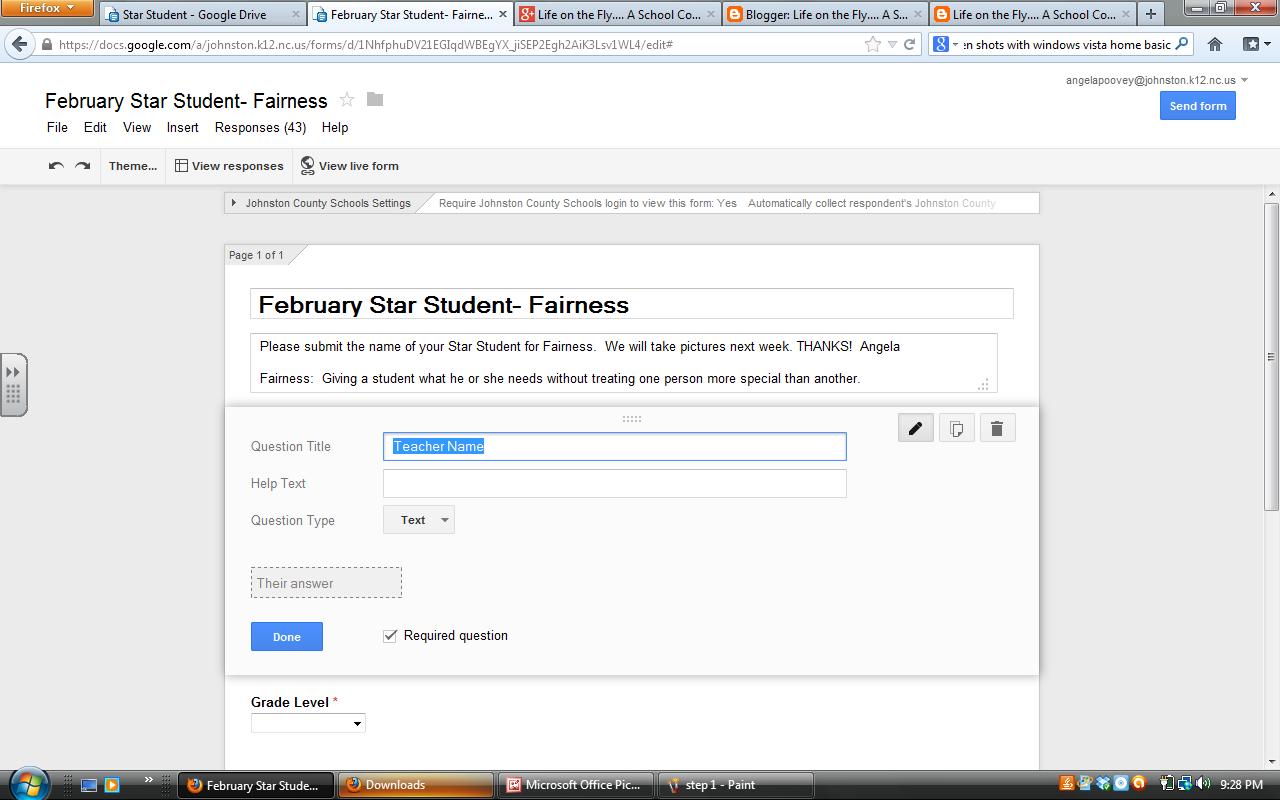
At the beginning of the year I decided to go paperless for my character trait award winners each month using Google Docs. I didn't want to have forty reply emails each time a month passed by and I needed to get the names. So, I created a Google form for my teachers. Here is how I do it:

First, I go to Google Drive, click on the "Create" button, and choose "Form". 


Then, I start to add the questions that I need.  You get to choose the answer type for each question you insert:  text field, paragraph text, multiple choice, checkboxes, choose from a list, scale, or grid.  For the Teacher Name and Student Name, I use the text field. 

I add the grade levels using the "choose from a list" question type. You can also check a box underneath the question that REQUIRES the teacher to answer the question before they can submit the information. This tool helps ensure you get all the information you need and no one forgets to answer a question.

 Once the form includes all the information I need to collect, I click "Send Form" at the bottom.  A pop-up box appears, and I enter my teachers' email addresses.  My school uses Google Mail and I have already created groups for my different grade levels so I can actually type in Kindergarten, First Grade, Second Grade, etc.........and it populates all the teachers' email addresses for me without me having to type each individual address.


Then, the teachers get a beautifully formatted email that they can fill out easily and submit in one minute (OR LESS).  


Once you are ready to collect all your data, you simply go to the "Responses" tab and click on View Responses.  All of your information will be in a fantastic, organized spreadsheet, which you can sort by grade level or teacher as you fill out certificates and plan your photo ops for the month. 

This monthly use of Google Docs is just one of the ways I have started simplifying my data collection so there are NO MORE slips of paper floating around my office.  I also used it recently for my behavior data collection prior to a classroom lesson - see Simon's Hook post- and will be sharing that info next.  
Happy counseling!    Angela
Related Posts Plugin for WordPress, Blogger...