Showing posts with label Classroom Guidance. Show all posts

Friday, September 9, 2016

Color me HAPPY!

*Image from hammertown.com

Have you caught the fever of the adult coloring craze?!! I bought the above book for my 5 year old daughter last Christmas because it caught her eye in a bookstore, and I thought we could color it together even if it was too hard for her alone. Kids and adults alike are LOVING coloring intricate designs.  You may remember my 2015 ASCA conference post when I learned about mandalas and started using them as an icebreaker and relaxation exercise during individual counseling.  It has continued to be a great activity for students of all ages, and I love it!

So, you can imagine my enthusiasm when I saw these AWESOME bulletin boards that our fantastic art teacher, Kim Pound, created for the start of school.


She did them freehand (YES!!!) to creative interactive boards where students could add pattern and color during Open House or other times during the day. I was so impressed that it got me thinking about how I could incorporate interactive coloring into my school counseling program.

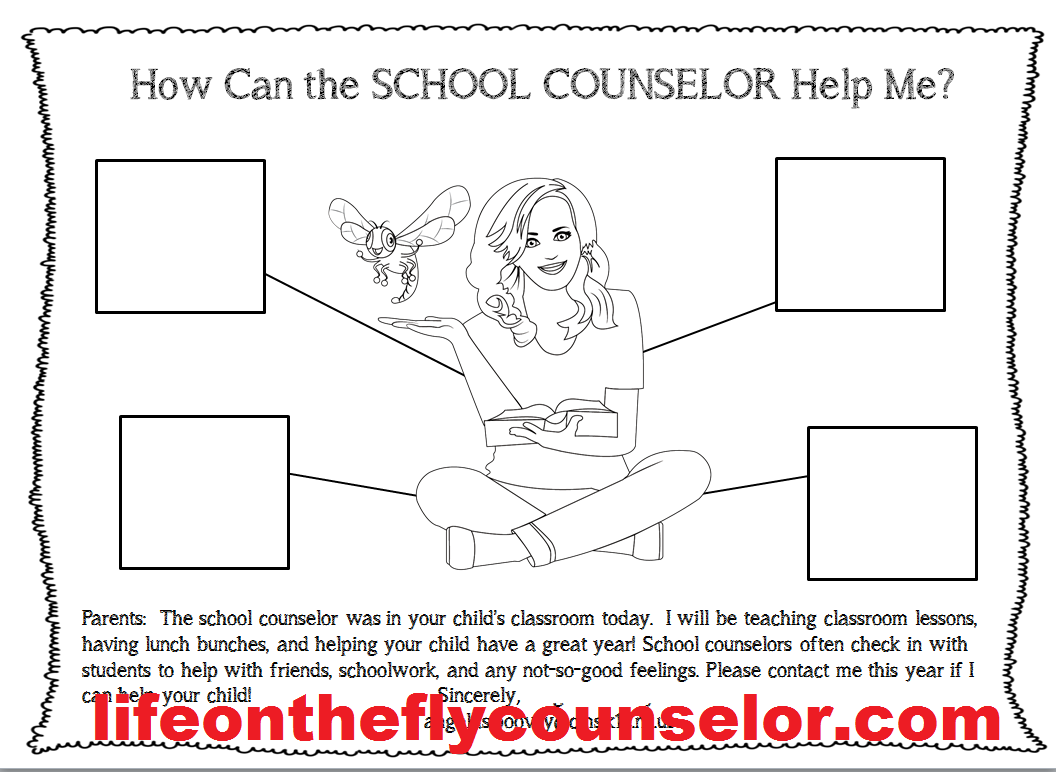
I am still wrapping my mind around a few "new student group" ideas, but I did add the coloring sheets below when I taught my Kindergarten and second grade Intro to the School Counselor Lessons (My avatar sheet was added at the end of the campfire lesson but is not in the bundle).  They serve a dual purpose of informing parents that I am the school counselor and spoke to their child's class AND helps kids remember how I can support them at school. Students will fill in the boxes around my avatar with ways I can help them this school year AFTER we have completed the lesson as a quick comprehension check;  it's kind of like my formative assessment to ensure no one missed the main points of the school counselor's role during the lesson.  This fantastic avatar line drawing is the beautiful work of Surfer Clips on TPT. I highly recommend him!


And if coloring doesn't make you happy, I hope this next news will!!! I finally reached 350 followers at my Life on the Fly TPT Store and am celebrating by putting my ENTIRE STORE ON SALE until Monday...yes, everything! 
Act quickly, enjoy, and Happy Counseling! ~ Angela

Saturday, August 13, 2016

Meet the School Counselor....

This post will be short and sweet because I only have six more days of summer vacation, and I want to squeeze every last minute out of my last Saturday.  I have had a LOT of fun introducing myself to students as the school counselor over the years and have written posts about how to make that fun. My #FlatGroovyPoovey and Camp Counselor lessons are two of the most popular items in my Life on the Fly TPT store.

So, what do you do when your students have already heard those intro lessons?!!! You add more to the rotation. I have been working on some cute new lessons and can't wait to use this Mrs. Potato Head student worksheet with my Kindergarten students.  I included a parent blurb at the bottom and will have them color the Mrs. Potato Head to take home at the end of the lesson.

I also created two new upper grade lessons, a race track themed SMARTboard lesson (I do live in NASCAR country!) where the class divides into teams and races against each other as they answer TRUE/FALSE questions about the school counselor and a "What Does the School Counselor Do?" game where students sort Counselor Cards into TRUE, FALSE, and DON'T KNOW piles to learn about my job.

If you are ready to add some new material and fun to your INTRO lessons, check out my new bundles! Then, pat yourself on the back for being ahead of the game and super organized! One of the bundles has SMARTboard resources and the other is lessons plans, activities, and student products (two of these work best with the SMARTboard resource). If you buy both, you will have FIVE NEW intro lessons to share with your students. Click on the images for more info.
One last thing--- my lucky readers will get 20% off the 3 new items I have posted this week for the next 36 hours. 

Enjoy and Happy Counseling! ~ Angela


Monday, August 8, 2016

Welcoming Diversity......


Merriam Webster's definition is a great reminder about the emotions a person should feel when we are welcoming someone.  Happiness. Pleasure. Is this how your students will feel on the first day of school when they enter your school building? What about on the 80th day? Or 180th day?


Embracing diversity has always been a priority for me as a school counselor. Years ago I created a really fun, hands-on Ability Awareness lesson with different activity centers that I wrote about here. It helps students see what it would be like to have physical or educational challenges so that empathy and compassion can be cultivated. Last year, I added more diversity lessons for my students and recently created this Diversity Lesson Bundle to share at Life on the Fly. The bundle lessons focus on appreciating physical differences, diversity of talents, and diversity of interests. 

Earlier in July I had the true pleasure of beginning training as a site-based facilitator for Welcoming Schools in my school district. As one of five counselors from my district included in the training, it was a unique opportunity for me to learn and grow.  Welcoming Schools is an approach that focuses on the following areas:
Embracing family diversity
Preventing bias-based bullying and gender stereotyping
Supporting transgender and gender expansive youth
Creating LGBTQ-inclusive schools

As educators, especially school counselors, it is our job to promote respect and tolerance so that ALL students are received and accepted with care and compassion.   
So, how do we do this in elementary school?

You may not have a transgender student walking through your doors in August, or a student that identifies as gay or lesbian, or even a student that currently has two moms or two dads, but are you building a school atmosphere that could embrace those situations and others if (and when) they occur? Because if you are in this profession long enough, it WILL happen and NOW is the time to educate and prepare students who are welcoming of students with LGBTQ differences, racial differences, family structure differences, gender differences, preference differences...the list goes on and on. 


One easy way to begin these diversity and tolerance conversations is with bibliotherapy.  Whether you do a classroom guidance lesson or read a book with a small group or individual student, books are a great place to start in planting seeds of tolerance. Welcoming Schools has some great lesson plans available for some of their recommended books. I also have recommended readings from other resources that I plan on checking out this year. Click on the book titles to read the summary of each story.

Family Diversity Books


The Family Book (Pre-K-K) and The Great Big Book of Families (Pre-K-3) are good starting points to present all different kinds of families with your primary grades.  And Tango Makes Three (Pre-K-3) is the story of a penguin with two dads.

Gender Diversity Books

Jazz Jennings, a transgender girl and national spokesperson for transgender youth, is the co-author of I Am Jazz (K-5)  She is also the star of the show "I Am Jazz" on the TLC network, which focuses on her life as a transgender teen growing up in Florida. George also tells the story of a young transgender girl. Jacob's New Dress (Pre-K-2) features a character who doesn't identify with stereotypical gender roles while Elena's Serenade (Pre-K-2) and 10,000 Dresses (K-4), also challenge gender stereotyping, especially as they relate to interests and possible careers.


Finally, Red:  A Crayon's Story is a delightful book where a blue crayon, labeled RED, struggles with identity and acceptance to be the crayon it is inside. Although this book could easily relate to LGBTQ topics, I believe it also presents a broader acceptance of diversity of self, no matter what the difference expressed.

Many of these books can be found on YouTube if you want to check them out prior to buying them or use them as e-books for lessons.  I am by no means an expert on these topics, but I am leaning into the learning curve and recognize the huge need to promote acceptance and respect for ALL types of families and ALL students. Join me in the important work of creating school environments that truly are welcoming!

Enjoy and Happy Counseling! ~ Angela

Thursday, July 28, 2016

It's the FINAL Countdown: Part II

I'm BACK and super excited about some upcoming posts to share resources (new books, websites, counseling resources, the list goes on and on).  I had four days of amazing professional development earlier in July and am also presenting at the Eastern Summer Academy for the NC School Counselor's Association TOMORROW! Nothing like the end of July to start getting you thinking about school again!

As promised, it is time for PART II of my Academic Habits post (and my first offer of bundled lesson plans EVER at my Life on the Fly TPT store....read to the bottom for your special READER deal). School counselors do SO MANY THINGS, and I am loving this infographic that I saw on school counselors affecting student success at the NYU Counseling website (click on the picture to see the entire infographic or visit my Life on the Fly FB page where it is also posted). Note the college readiness and academic outcomes that fit right in line with this post. There are some pretty awesome stats here; perhaps you should also send it to your school administration!

Where are We? 

I ended my last post sharing the data I had collected from my fifth grade students and teachers on what academic habits they needed most to affect their future success.  Although they identified listening skills, study skills, and organization as the most critical, I narrowed it down to two topics that would be most developmentally appropriate, as well as fit into our time constraints for fifth grade.  As an aside, I am constantly thinking about how guidance curriculum spirals through the grades so that by the time students go through K-5 at my school, they will have received multiple lessons presenting varied academic objectives within that domain.  This year, that spiraling curriculum looked like this for my grade levels in bold (and what I have taught for the other grade levels when I was a solo counselor):

K: School is my Job! (Positive feelings toward work and learning)
1:  Whole Body Listening
2:  Homework Habits
3:  Goal Setting, Organization of Materials (backpacks, cubbies, desks)
4:  Goal Setting, Organization of Time 
5:  Goal Setting, Learning Styles

Since I was not responsible for fourth grade this year and my fifth grade students identified organization of time as an area they needed help on, I actually presented lessons on goal setting, learning styles, and organization of time with them. Here's how......


The Lessons: Learning Styles and Organization of Time 
Learning Styles
My fifth grade students all have Chromebooks so I was able to share bit.ly links with them as we viewed many of the materials in these lessons. It was amazingly efficient and so kid-friendly! We started with Learning Styles because I wanted to tackle study skills in an intentional and personalized way.  Students completed a pre-test on what learning styles they already knew. I have really been enjoying having older students use the same pre/post ticket (like the example below) during lessons to measure growth.  They draw lines through pre-test blank spaces if they don't know the information at the beginning of the lesson and then write it in for the post-test information once they do. I collect them as an exit ticket at the end of the lesson and use it for my program results data at the end of the year.
I then reviewed the following infographic from UltraLinx (yes, I love infographics!) and students predicted what learning style would fit them best to a partner. The students took the following short quiz found at Educationplanner.org on their Chromebooks to get their learning style results.  One of the reasons I like this quiz is because it gave hybrid results. For example, it might say a student was 70% visual learner and 30% auditory learner rather than giving one rigid type. This flexibility is more applicable to real life and helps kids get away from "inside the box" thinking.

After receiving their quiz results, students were grouped based on their most dominant learning style, which meant I had to be flexible with materials and table groupings since I was never sure how many students would fit in each category. I stayed organized with table cards showing each assigned group.  Then, I gave students overview sheets I created on their dominant learning style and asked them to apply it to a teaching activity. Each group used current Science or Literacy vocabulary (I collaborated with their teachers to create these lists) and planned a way to teach one vocabulary word to the class using their particular learning style. The analysis and application (think Bloom's taxonomy higher order thinking) really helped them internalize their learning style.  Students came up with everything from poems to raps to dances to drawings to teach their words, and it was a fun way for them to practice oral presentation skills, too.

Time Management
Our second academic habits lesson focused on time management, which I also emphasized as an ultra important topic for middle school.  Students started out by sharing all the different extracurricular commitments and homework responsibilities they have. Nothing gets kids more excited about a lesson than being able to talk about themselves, and I have found that turn & talk or stand up, hand up, pair up conversations are a good way to get the ball rolling.  Check out Spencer Kagan for more structured cooperative learning ideas.

Next, students paired up and accessed my Google Drive lesson via a bit.ly link (again, super easy and efficient if you have that capability).  I had students make a copy of my lesson once they were in their own Google drive so they could discuss the activities and actually type in the document without affecting others.  Students read a sample fifth grade after-school schedule for "Ashley," and we talked about Need to Do versus Want to Do tasks. Then, they organized her schedule electronically in a chart.  Then, they brainstormed discussion questions, which we also shared out as a whole group.  

Finally, students picked one school day and created their own afternoon schedules. I allowed students to choose whether they wanted to create their schedule electronically with my template or with a paper version. We shared model examples of prioritizing time (homework first, including daily reading, getting exercise) as students completed the activity.

This lesson didn't have a pre/post written component, but in the future I plan on using four corners to gather some perception data about how well students think they are doing with organizing time before the instruction and after the instruction.

So, there you have it.  The final countdown for this post is over, but it has just started for the beginning of the 2016-2017 school year! I am down to 21 days in my neck of the woods and plan on enjoying every single one of them before I head back to my school kiddos. I hope I can save you some time and help you enjoy your days MORE by offering my first ever lesson bundle at Life on the Fly TPT. This K-6 bundle includes four lessons (including the two in this post) so you can check that domain off your list for next year! As a special deal for my Life on the Fly readers, I am giving an extra 25% OFF if you buy in the next 24 hours.  

Enjoy and Happy Counseling! ~ Angela


Saturday, April 23, 2016

It's the Final Countdown......Part I

                                                                              *image from wikipedia.org

It's the final countdown (cue drums and bad 80s hair)....fourth quarter. I have 33 school days to support my students in reaching their goals, whether that means we are trying to improve a report card grade, pass the EOGs, avoid behavior referrals, or have better attendance; the time is now. So, what am I doing?

Right now 
I am using my report card conference form to review third quarter report cards and help students make fourth quarter goals for specific subjects. I will also be starting my test success small groups with third and fifth graders who need that extra push to pass the EOGs. The fifth graders are students who missed passing last year's EOG by one to two points, and the third graders are "bubble students" as determined by the "Beginning of Grade" (BOG) test data and mock EOG data.  

Do you see a theme here? All of these interventions require looking at data to determine who I should be supporting; they require data to determine what the next steps should be for students as they move toward their next goals.  The focus is on making progress, moving forward, and having a growth mindset.  Good teachers do a great job of using formative assessments to inform their interventions and drive instruction.  Counselors can do the same.

You may remember this goal-setting post from the beginning of the year where I used my new goal-setting form (FREEBIE NOW at my TPT store), SMARTboard slides,  and lesson plan to help fifth graders create goals for the year.  Most years, I help students create goals in September and then I move on, hoping, wishing, and crossing my fingers that they will reach them. This year I challenged myself to return to goal setting and do more.

Using Data:  The Objective
I decided I wanted to use minute meetings to follow up with students about their goals and collect qualitative data that would inform my next steps in supporting them with academics.  I knew I wouldn't have enough time to interview ALL 120+ fifth graders from ALL six classes so I worked to get a majority sample from a majority of the classes. I ended up talked to students from four out of the six classes.

The Plan
I had hoped to begin my minute meetings as soon as first quarter ended (end of November), but "school counseling" happened, and they didn't begin until December with the bulk of the meetings being completed in early January.

I created a Google survey to review goals with students and asked the following (see below):

  • Did you meet your first quarter goal?
  • If not, why not?
  • Do you have a new goal for third quarter?
  • What would help you most in reaching your goal?


The Outcome
Here is some of my survey data (I love the summary of responses view in Google!).  It was helpful for me to see that 37% of the students I interviewed did not meet their first quarter goal and 21% couldn't remember what their goal had been.  It validated my decision to return to goal setting and take time to collect formative data on how to support students best in my next steps.


As I talked to students about what skills would help them be most successful for the rest of the year (below), several habits became prominent:  Organization of Time, Study Skills, and Listening Skills. The "other" responses were typically students saying they needed help in TWO areas, which I typed out. After reviewing the percentages, written responses, and getting feedback from the classroom teachers, I decided to focus on study skills and organization of time.


Next Steps
I created two academic habits lessons for my fifth grade students, personalized to their needs. Teachers were given the option of having both lessons or choosing the one that best met their students' needs. Most of the teachers chose both lessons.  Part TWO of this post will review those lessons.

Reflection
I was proud of the growth I made in using my data collection as a formative tool to drive my instruction and interventions.  Feeling comfortable with data and using it effectively is one of the great challenges that most school counselors face, myself included. I have gone from groaning when I am presented with data to getting excited about  it. My perception has shifted. I now realize that student data is not the end of the story; it's the the first paragraph of the next chapter as students continue their story.

Happy Counseling! ~ Angela

Saturday, February 13, 2016

All About Organization

Clutter.  Loose Papers. Trash. Old Snacks. Broken Pencils. Are you having flashbacks of any of the student desks at your school?! I hope the above picture is an extreme example, but organization is an area where many students struggle, especially as they move into the upper elementary grades.  I decided to tackle this important academic habit with my third graders in classroom lessons in January and February.  Depending on the classroom teacher, my third grade students have desks, book boxes, or cubbies they use to keep materials organized; some of the classrooms use tables instead of desks, but they all have some type of organizational system.

My lesson started with students brainstorming all the areas they could organize at school.  After a
sharing discussion, we specifically pinpointed the areas of backpacks, desks, and cubbies, and students rated their current level of organization 1-3 on a pre-test (3 was best). Next, we tacked backpacks and students had to transform my LEVEL 1 backpacks into LEVEL 3 backpacks while also completing a backpack scavenger hunt.  Each team received a scavenger hunt card of 5 items they had to find within the backpack while also organizing it. This activity was a great way to practice teamwork AND organizational skills!  I also used this fun rocket timer found here to jazz up the scavenger hunt a little more.

After students completed the scavenger hunt, we discussed the steps they took to organize the backpacks and students reflected on the changes they needed to make with their own backpacks. Students circled the specific strategies they could use on their pre-survey. Next, we tackled desks or book boxes/cubbies.  Again, students rated themselves on their current level of organization, 1-3. They completed a planning template of whichever area they were organizing, and we highlighted model examples as students completed the templates.

The final step was letting students know that there would be a check-in from the "desk fairy" or "organization fairy" in a few weeks to see if they had implemented any of the organizational strategies.  One important note is that I asked teachers to allow a few minutes during arrival and dismissal time so students could practice what we learned. That practice time is key if we want students to be successful and will affect how these follow up checks go.

So far, I have visited three classrooms and handed out special desk check "congratulation notes."  As always, I can tell some students really took the lesson to heart and are improving while others haven't invested the time to make changes yet.  I will return to the classrooms for a quick post-test (on the back of my pre-test) where they will rate themselves 1-3 again and do some reflection about whether they have followed through on the strategies they circled.  This lesson is really about promoting awareness of organization, its importance, and the specific strategies students can use to not be "that kid with the overflowing desk."

If you are interested in teaching this lesson and want my pre-made lesson plan, pre/post survey, planning templates, congratulations notes, and scavenger hunt cards all in one EASY packet, check it out here at my Life on the Fly TPT store.

Enjoy and Happy Counseling! ~ Angela

Wednesday, October 21, 2015

No Bullies Allowed!

It is October and time for bullying prevention awareness activities in schools everywhere! Should October be the only time we talk about bullying prevention?! NO! But, is it a great time to teach students how to handle bullying and prepare them for the potential threat of bullying?! Of course!  At our school, my co-counselor and I created a schedule of events for the month.  We sent out a memo to parents and staff at the end of September so they could gear up for the  upcoming bullying prevention activities.

We chose to wear blue and STOMP out bullying on October 5th as part of the national recognition day. Then, we held our spirit week October 12th-16th.  Check out our daily themes above and how students participated below!


Those were fun days especially crazy sock day with my Wonder Woman cape socks (yes, you need some!), but the bulk of my emphasis has been on weekly guidance lessons in first, third, and fifth grade classrooms.

I showed my all-time favorite RESPECT RAP on the morning show to students and was able to use it as a jumping off point when I made FRIENDSHIP PIZZAS with my first graders. I have written about this lesson before here and finally put my lesson plan and SMART board notebook file on TPT. Download it NOW because the lesson plan is FREE for the next 48 hours!!! 


In third and fifth grades I used the Steps to Respect Curriculum from the Committee for Children (makers of Second Step). I still haven't found anything I like better!  I created my own Smartboard lessons teaching the 3 Rs, Recognize, Refuse, and Report. I love incorporating movie clips when we are learning how to RECOGNIZE the  bullying definition.  This year I used two video clips --the Sneetches and A Christmas Story-- to process the three essential bullying definition questions:
1)  Is it one-sided?
2)  Does it keep happening?
3)  Is it hurting, frightening, threatening, or leaving someone out on purpose?

The Sneetches clip was a new addition, and it worked out  really well. I even added the cartoon figures to my bullying prevention bulletin board so students would have a visual reminder of the 3 Rs and the refusing words.


I intentionally left a lot of clear space on this board because 3-5 students have been challenged to integrate what they have learned in the Steps to Respect lessons into original work products like posters, cartoons, poems, songs, raps, or any other creative work.  I will post any entries I get and PTO donated "bucket filler"  spirit sticks that I can give for participation prizes. Do you know about spirit sticks?! They are ultra popular at my school this year!

I brought back my Friendship Pizza bulletin board, too, with a few changes like teacher pics....the kids always get a kick out of them!


Our final week in October will include sharing bullying statistics on the morning show and a scavenger hunt on the playground for "NO BULLYING" cards just to keep bullying prevention on students' minds.  What have you been doing this month?! I would love to hear!
Enjoy and Happy Counseling! ~ Angela
Related Posts Plugin for WordPress, Blogger...